
Automotive manufacturers deal with one of the most demanding marking environments in any industry. Every component — from piston rings and chassis brackets to airbag housings and tube assemblies — needs permanent identification that survives the harshest operating conditions. But not every marking application requires the same approach. Color laser marking and high-contrast black or white marking serve different purposes. Choosing the wrong one wastes cost or compromises readability in the field.
This blog breaks down the practical difference between color laser marking and black-and-white marking for automotive parts. It covers how each process works, where each delivers the best result, and which SLTL laser marking systems are built to handle both — from high-volume traceability marking on piston rings to precision 2D/3D DataMatrix coding on chassis assemblies and tube components. Whether you are specifying a new marking system or evaluating your current process, this guide gives you the technical foundation to make the right choice.
Introduction
In automotive manufacturing, a mark is not just an identifier. It is a permanent production record. It carries batch data, compliance information, traceability codes, and brand identity across the full lifecycle of every component it touches.
Color laser marking automotive parts is a growing capability — particularly on stainless steel and aluminium components where visual differentiation, premium branding, and anti-counterfeit marking add genuine value. At the same time, high-contrast black and white marking remains the standard for functional industrial traceability, DataMatrix codes, serial numbers, and compliance marks where scan reliability is the absolute priority.
Both processes use laser technology. However, they work through different physical mechanisms, on different material types, and for different end purposes. Understanding which method suits which application is the decision this blog is designed to support.
Why Color Laser Marking Automotive Parts Matters in Manufacturing
Automotive traceability requirements have expanded significantly over the last decade. OEM supply chain visibility, IATF 16949 compliance, and warranty management systems now demand component-level identification — not just assembly-level tracking. Every individual part must carry a permanent, machine-readable mark from production through to end-of-life.
Traceability Is Now Mandatory at Component Level
A chassis bracket, a piston ring, an exhaust tube joint — each of these must be traceable back to its production batch, material certificate, and manufacturing date. Furthermore, safety-critical components including airbag housing parts and brake system brackets require documented traceability in most regulated markets.
Laser marking delivers this traceability reliably. The mark is permanent, non-contact, and machine-readable. Moreover, it integrates directly with MES and ERP production databases — capturing traceability data in real time without manual scanning steps.
Brand Protection and Anti-Counterfeit Marking
Counterfeit automotive components cause real safety risks. Fake brake pads, substandard bearings, and non-compliant electrical connectors enter the supply chain through legitimate-looking parts without permanent origin marks.
Color laser marking automotive parts creates a visual authentication layer. A colour-marked logo or serial identifier on a stainless steel component is extremely difficult to replicate with conventional tools. Therefore, it provides a brand protection function that standard inkjet or dot-peen marking cannot match.
Quality Control and Smart Manufacturing Integration
Laser marking systems connect directly to smart factory infrastructure. They communicate with SCADA platforms, vision inspection systems, and MES databases in real time. Consequently, every marked part is logged automatically — creating a continuous production data stream that supports quality analytics and predictive maintenance programmes.
The shift toward integrated laser-based production in automotive manufacturing — covering not just marking but cutting and welding — is covered in detail in Why Automotive Part Makers Are Moving from Conventional Cutting to Laser Cutting. It provides the full context for how marking fits into a broader laser production system.
Benefits of Color Laser Marking for Automotive Traceability
Color laser marking delivers functional and aesthetic advantages that conventional marking methods cannot replicate. Here is what it brings to automotive production.
Permanent, Non-Contact Identification
The laser beam never contacts the component surface. It delivers focused energy to the mark area and produces a surface-level change through controlled oxidation or ablation. Consequently, there is no mechanical stress, no tool wear, and no surface contamination beyond the mark itself.
The resulting mark is formed in the metal — not applied on top of it. It does not peel, fade, or wash off under engine oil, cleaning solvents, or thermal cycling. Moreover, it survives the full operational life of the component without degradation.
High-Speed Marking for Automotive Production Volumes
Laser marking systems operate at marking speeds measured in seconds per component. A DataMatrix code and serial number on a piston ring marks in 3–8 seconds. A complex logo mark on a chassis bracket marks in 5–15 seconds. Furthermore, automated feeding systems maintain continuous throughput without operator intervention between cycles.
This production speed is essential for automotive suppliers running high-volume lines where marking must keep pace with upstream machining and downstream assembly.
Color Marking for Component Differentiation
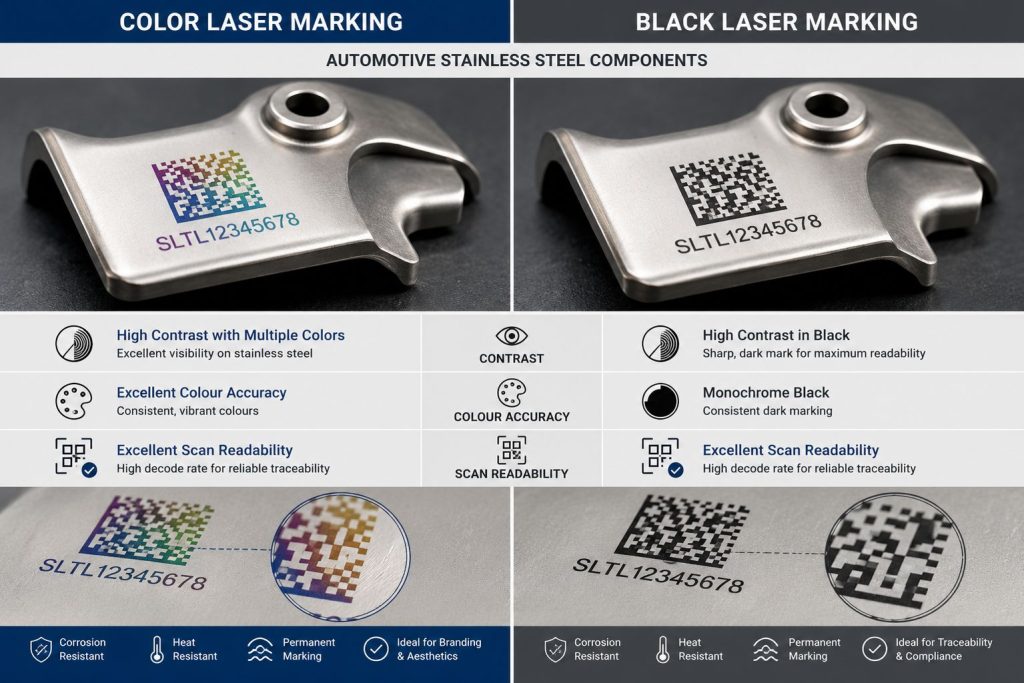
Color laser marking on stainless steel and titanium produces the full visible spectrum — blue, gold, red, purple, green — through controlled surface oxidation. These colour marks enable:
- Variant differentiation — different colours for different component grades or specifications
- Visual quality gates — colour-coded inspection status marks for automated sorting systems
- Brand identity — premium colour logos on high-visibility stainless components
- Anti-counterfeit layers — colour pattern marks that are extremely difficult to replicate
Additionally, colour marks are permanent and chemically stable on stainless steel. Therefore, they survive the cleaning cycles, lubricants, and environmental exposure that automotive components encounter in service.
Black Marking vs White Marking for Automotive Components
Black and white marking are the two high-contrast options for functional automotive traceability. Each suits specific material types and applications. Choosing correctly determines scan reliability, mark durability, and readability across the full component lifecycle.
High-Contrast Black Marking for Industrial Identification
Black laser marking works through a controlled annealing process. The laser heats the metal surface to a specific temperature range, producing a dark oxide layer without removing material. The result is a deep black mark with high contrast against the base metal surface.
Black marking is the preferred choice for:
- Stainless steel automotive components — high contrast on the polished or brushed steel surface
- DataMatrix and QR code traceability — dark marks on light backgrounds produce the highest scanner read rates
- Serial number and batch code marking — permanent, machine-readable identification
- Piston ring identification — black annealing marks survive engine operating conditions
Furthermore, black annealing marks produce no material removal. The surface remains intact below the oxide layer. Consequently, the component’s structural integrity and surface geometry are fully preserved.
White Marking for Dark and Coated Surfaces
White laser marking works through controlled ablation — the laser removes the surface layer or coating to reveal a lighter material beneath, or creates a surface texture change that appears bright against a dark substrate.
The following are the most common white markings:
- Anodised aluminium — removing dark anodised coating to reveal the bright aluminium beneath
- Powder-coated components — ablating the dark coating to reveal a bright white mark on the substrate
- Dark painted automotive parts — high-visibility identification on black or dark grey surfaces
- Interior component marking — clean white marks on dark plastic or coated trim components
Moreover, white marks on dark surfaces deliver higher visual contrast than black marks on dark backgrounds. Therefore, white marking is the right choice when component colour makes black marking invisible or unreadable under inspection conditions.
Choosing Between Black and White Marking
| Factor | Black Marking | White Marking |
|---|---|---|
| Best material | Bright stainless steel, light metals | Dark anodised, coated, or painted surfaces |
| Mechanism | Surface annealing (no material removal) | Surface ablation (material removal) |
| Scanner readability | Excellent on bright backgrounds | Excellent on dark backgrounds |
| Durability | Extremely high — annealed into surface | High — depends on depth of ablation |
| HAZ | Minimal | Minimal |
| Applications | Piston rings, stainless brackets, DataMatrix codes | Anodised aluminium, powder-coated parts, dark plastics |
Compatible Materials for Automotive Laser Marking
Both black and white marking, alongside colour marking, work across all common automotive materials:
- Stainless steel — black annealing marks, colour oxidation marks
- Aluminium and anodised aluminium — white ablation marks, colour marks on bare aluminium
- Titanium — colour marks through rich oxidation spectrum
- Coated and painted metals — white ablation marks through surface coating
- Industrial plastics — CO2 laser marking for ABS, polycarbonate, and engineering plastics used in automotive interior and sensor housings
Applications of Color Laser Marking Automotive Parts
Color laser marking automotive parts covers a wide range of production applications across the automotive component supply chain.
Piston Ring Marking
Piston rings require permanent, machine-readable identification that survives combustion temperatures, honing fluid, and engine oil. Black annealing marks — DataMatrix codes, serial numbers, batch identifiers — are the standard approach. The mark survives the full engine operating lifecycle without degradation.
High-volume piston ring production requires a marking system that integrates with automated feeding systems and marks at line speed. Additionally, inline vision verification confirms mark quality before the ring moves to the next production station.
Chassis Component Identification
Chassis brackets, sub-frame members, and structural reinforcement plates require traceability marking for OEM supply chain compliance. Black DataMatrix codes on bare steel or stainless surfaces provide the scan reliability that automated receiving inspection systems require.
For chassis components processed using laser cutting, marking follows naturally as the next production step in an integrated laser workflow. The broader case for laser-based chassis production is covered in the detailed guide on automotive laser welding for stronger chassis assemblies — which explains how cutting, welding, and marking work together in chassis manufacturing.
Tube Component Identification
Exhaust tubes, frame tubes, and seat structure tubes all require permanent part identification after cutting and before welding. Laser marking applies serial numbers and batch codes to tube surfaces in seconds — integrating into the tube processing line without disrupting production flow.
2D and 3D Job Marking on Automotive Components
Flat chassis sheet components use 2D marking — the focal plane is fixed and the galvo scanner covers the mark area. Curved components — cylinder bores, connecting rods, camshafts, and cast housings — require 3D marking, where the focal position adjusts dynamically to maintain consistent spot size across the curved surface.
Furthermore, connecting all these marked components to a central database through their DataMatrix codes creates the component-level traceability architecture that IATF 16949 and OEM supply chain requirements increasingly demand.
Airbag Component Marking
Airbag housing components require marking that survives the stored energy environment of a deployed airbag system. Black annealing marks on stainless steel housing parts provide the permanent identification that safety-critical component traceability requires.
VIN and Compliance Marking
Vehicle Identification Number (VIN) marking on structural components and ID plates uses laser marking for permanence and tamper-evidence. Colour marking adds visual authentication capability to VIN plates — a colour-marked security pattern is far harder to replicate or alter than a standard engraved mark.
SLTL Automotive Laser Marking Solutions for Industrial Manufacturing
SLTL Group provides a complete range of laser marking systems for automotive manufacturers — covering color marking, black annealing, white ablation, and CO2 marking across all automotive material types.
REX — Diode Laser Marking System
The REX is SLTL’s diode laser marking system, designed for traceability marking applications in automotive production. Its compact form and reliable diode source make it an accessible entry point for suppliers adding laser traceability marking to existing production lines. It handles standard traceability codes, serial numbers, and batch identifiers efficiently.
ELITE — Fiber Laser Marking System
The ELITE is a fiber laser marking system optimised for precision industrial marking applications. It produces consistent mark geometry — both black annealing marks for DataMatrix traceability and colour marks for brand identification — across all standard automotive metal substrates. For automotive suppliers running high-precision marking requirements on stainless steel and aluminium components, the ELITE delivers the mark quality and consistency that automated inspection systems require.
Explore SLTL’s color laser marking automotive parts solutions for traceability and branding applications.
Flexy — Movable Diode Laser Marking Machine
The Flexy is a portable diode laser marking machine designed for marking difficult automotive parts — large assembled components, parts that cannot be easily fixtured on a standard marking table, and production environments where the marking station needs to move to the workpiece.
Moreover, its movable configuration makes it ideal for marking chassis assemblies, tube structures, and large fabricated components after assembly — where the assembled geometry prevents standard fixture-based marking.
NEO — Fiber Laser Marking Machine (20–60W)
The NEO is SLTL’s multipurpose high-power fiber laser marking system in the 20–60W range. It handles the full range of automotive marking applications — DataMatrix codes, serial numbers, logo marks, and QR codes — on all metal substrates at high throughput.
Its higher power range delivers faster marking speeds on demanding applications where production volume is high and cycle time is a critical constraint. Additionally, the NEO handles colour marking on stainless steel and titanium with the power stability that consistent colour reproduction requires.
Ultra — Fiber Laser Marking Machine (20–120W)
The Ultra covers the 20–120W range — SLTL’s most versatile fiber laser marking platform for automotive production. It handles both fine precision work (micro-text, high-density DataMatrix codes) and higher-power applications (deep engraving, fast production marking on large batches) on a single platform.
Furthermore, its power range makes it suitable for the full spectrum of automotive marking requirements — from piston ring serial numbers to VIN plate marking and chassis component identification. Discover SLTL’s industrial automotive marking systems for your production environment.
OptiFly — CO2 Laser Marking Machine
The OptiFly is SLTL’s CO2 laser marking system for plastic marking in mass production environments. Automotive sensor housings, ECU enclosures, connector blocks, and interior trim components made from ABS, polycarbonate, and engineering plastics all benefit from CO2 laser marking — producing high-contrast black marks on plastic surfaces without ink or consumables.
For automotive suppliers marking plastic components at high volume, the OptiFly delivers the production speed and mark consistency that manual or inkjet-based plastic marking cannot match.
Carbon — CO2 Laser Marking System
The Carbon handles CO2-based marking applications where alternative configurations are required — different power levels, specific material types, or production line integration needs that the OptiFly’s configuration does not accommodate. It extends SLTL’s CO2 marking capability to the full range of plastic and non-metal material types in the automotive production environment.
Upgrade Automotive Marking with SLTL Laser Technology
Automotive manufacturers need marking solutions that are permanent, fast, traceable, and compatible with smart manufacturing infrastructure. Conventional marking methods — inkjet, dot-peen, hand stamping — cannot meet all of these requirements simultaneously.
SLTL’s complete range of laser marking, cutting, and welding solutions gives automotive manufacturers the integrated production toolkit for modern precision manufacturing.
What SLTL laser marking delivers:
- Permanent automotive marking — marks formed in the material, not applied on top of it
- High-contrast identification — black, white, and color marks optimised per material and application
- Faster production — 3–15 second marking cycles with automated integration
- Better traceability — machine-readable DataMatrix codes linked to production databases in real time
- Smart manufacturing — MES, SCADA, and ERP connectivity from day one
- Reduced operational errors — digital programme control eliminates manual marking variability
- Industry 4.0 readiness — digital-native platforms for connected automotive production environments
Contact SLTL today to discuss your automotive marking application, request a sample mark on your specific component and material, or specify the right system for your production volume and traceability requirements.
Conclusion
The choice between color laser marking automotive parts, black marking, and white marking is not a matter of preference — it is a technical decision based on material type, background contrast, scanner readability requirements, and the specific function the mark needs to serve.
Color marking delivers premium visual identity and anti-counterfeit capability on stainless steel and titanium. Black marking provides the high-contrast, machine-readable traceability marks that DataMatrix codes and serial number systems demand on bright metal surfaces. White marking serves dark-background applications — anodised aluminium, powder-coated parts, and dark plastics where black marks become invisible.
Furthermore, marking is most effective as part of an integrated production system. Combined with laser cutting for component manufacture and laser welding for structural assembly, laser marking completes the production workflow — delivering the precision, traceability, and quality that modern automotive OEMs expect from every tier of their supply chain.
SLTL’s complete range of marking systems — from the REX for accessible traceability marking to the Ultra for full-spectrum high-power production marking — gives automotive manufacturers the capability to mark correctly, permanently, and at production speed.
Frequently Asked Questions
Q1: What is the difference between color laser marking and black laser marking on automotive parts?
Color laser marking uses controlled surface oxidation to produce visible spectrum colours on stainless steel and titanium — used for branding, anti-counterfeit marking, and variant differentiation. Black laser marking uses annealing to produce a dark oxide layer on bright metal surfaces — used for DataMatrix codes, serial numbers, and traceability marking where scanner readability is the priority. Both are permanent and non-contact. The right choice depends on the material, the background contrast needed, and the functional purpose of the mark.
Q2: How durable is color laser marking on automotive components in service conditions?
Color laser marks on stainless steel are formed through a permanent surface oxidation — the colour is the metal surface in a different oxidation state, not a coating. These marks survive engine cleaning agents, lubricants, vibration, and thermal cycling without colour change or fading. On components operating in harsh environments — exhaust system parts, underbody brackets — the durability of colour marks equals that of the base metal surface itself.
Q3: What automotive materials are compatible with color laser marking?
Color laser marking produces the richest colour range on stainless steel and titanium. Aluminium produces colour marks in a narrower range. Carbon steel and mild steel are typically marked with black annealing or white ablation rather than colour oxidation — the colour effect is less distinct on these materials. For plastic automotive components, CO2 laser marking produces high-contrast black marks rather than colour effects.
Q4: How does laser marking integrate with automotive production lines and traceability systems?
SLTL laser marking machines support standard industrial communication protocols — OPC-UA, serial RS-232, and Ethernet. They connect directly to MES, ERP, and SCADA systems. Each marked component is logged in real time — the DataMatrix code links the physical part to its complete production record without manual data entry. This makes laser marking fully compatible with Industry 4.0 automotive production environments.
Q5: When should an automotive manufacturer choose white marking over black marking?
White marking is the right choice when the component surface is dark — anodised aluminium, powder-coated steel, painted surfaces, or dark engineering plastics. On these surfaces, black marks disappear against the dark background and become unreadable by scanners. White ablation marks create a high-contrast light mark against the dark surface — delivering the scanner readability that traceability systems require.

Leave a Reply