
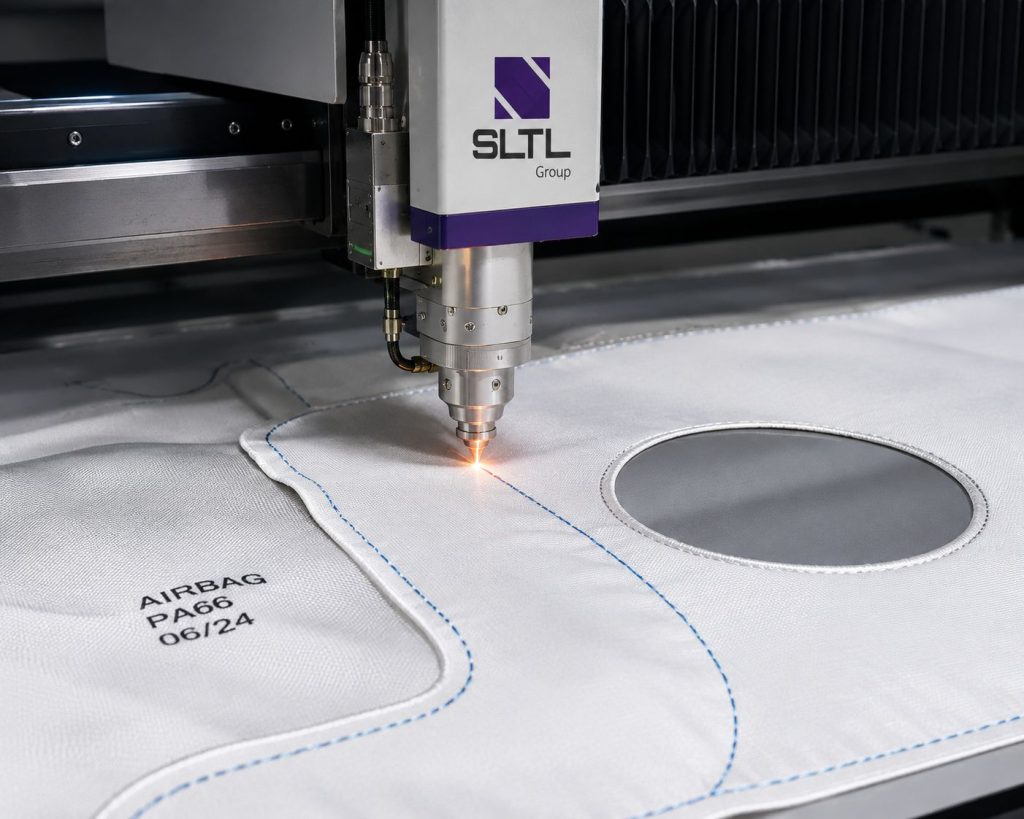
Automotive manufacturing is changing fast. Vehicles today use more composite materials, technical textiles, and layered safety components than ever before. Airbag systems, carbon fiber panels, EV battery insulation, and interior reinforcement layers all require precise cutting. However, these materials cannot tolerate the pressure, heat, or friction that conventional cutting tools generate. This is exactly where a laser cutting machine for composite material becomes essential. It delivers contactless laser processing that cuts cleanly, consistently, and without damaging delicate material structures — making it the right technology for modern automotive manufacturing.
Traditional mechanical cutting methods — rotary blades, die cutting, and mechanical punching — were designed for rigid metals. They work poorly on soft, layered, and fibrous materials. Furthermore, they cause fraying, delamination, and edge contamination on composites. These problems directly affect safety-critical components like airbags. As a result, manufacturers are replacing conventional methods with contactless laser processing.
This blog explains why contactless laser cutting is essential for airbag and composite material processing. It covers the key benefits, the most important applications, and the SLTL laser systems built for this work.
Why a Laser Cutting Machine for Composite Material Is Important in Automotive Manufacturing
Modern vehicle design depends heavily on composite materials. Manufacturers use them to reduce weight, improve safety, and meet tighter emissions targets. However, processing these materials correctly requires technology that conventional tools cannot provide.
Composite Materials Are Now Everywhere in Vehicles
Carbon fiber reinforced polymer (CFRP) appears in structural panels, roof sections, and performance body components. Technical textiles form the core of airbag systems. Multi-layer composite sheets reinforce EV battery enclosures and floor structures. Interior trim components combine foam, fabric, and rigid backing layers.
Additionally, the EV manufacturing sector has accelerated composite material adoption. Lightweight battery housings, thermal insulation layers, and structural crash components all use composite and layered material construction. Therefore, automotive manufacturers need cutting systems that handle this material variety reliably.
Traditional Cutting Methods Cannot Handle These Materials
Mechanical blades and rotary cutters apply direct pressure to the material. On woven composite fabrics, this pressure causes fiber fraying at cut edges. On multi-layer materials, it causes delamination — the separation of bonded layers along the cut line.
Furthermore, mechanical cutting tools wear down quickly on abrasive composite materials. Consequently, cut quality degrades across a production run as the blade loses sharpness. This is unacceptable for safety-critical airbag components, where cut edge quality directly affects deployment performance.
Die cutting requires expensive hard tooling for each component shape. Moreover, any design change requires new tooling — adding cost and lead time. For automotive suppliers managing multiple airbag variants across platform families, this tooling dependency is a significant operational constraint.
Airbag Manufacturing Has Zero Tolerance for Defects
Airbag systems are safety-critical. Every component in the deployment system — fabric panels, tether straps, gas diffuser covers — must meet exact dimensional and edge-quality specifications. A single frayed edge or dimensional deviation can affect folding behaviour and deployment timing.
Therefore, the cutting process must be perfectly consistent across thousands of components per production run. A laser cutting machine for composite material delivers this consistency — digital programme control means every cut is identical to the first, regardless of production volume.
Benefits of Using a Laser Cutting Machine for Composite Material
Switching to laser-based composite cutting delivers measurable advantages across airbag and automotive composite production. Here is what manufacturers gain.
Contactless Cutting — No Pressure, No Damage
The laser beam never physically contacts the material. Instead, it delivers focused energy directly to the cut line. Consequently, there is zero mechanical pressure on the material surface. Woven fiber structures remain intact up to the cut edge. Layered composites stay bonded. Foam backing layers do not compress or tear.
This contactless characteristic is the single most important advantage for airbag fabric and composite sheet cutting. It is what makes laser cutting the only practical technology for these material types at production volume.
Reduced Fraying and Clean Edge Finishing
On woven airbag fabrics, laser cutting seals the fiber ends at the cut edge through controlled thermal action. As a result, fraying is eliminated — or reduced to a negligible level. The cut edge is clean, sealed, and consistent across the full cut length.
This edge quality directly affects airbag folding and deployment performance. Furthermore, it eliminates the secondary edge-sealing operations that mechanical cutting often requires on woven materials.
High-Speed Cutting Capability
Laser cutting systems process composite materials at high speeds — significantly faster than die cutting on complex shapes and far faster than manual cutting operations. Moreover, automated material handling systems feed material continuously, maintaining production speed without operator intervention between cycles.
For high-volume airbag production, this speed advantage reduces per-unit cycle time and increases throughput without any reduction in cut quality.
Minimal Material Wastage
Laser cutting software optimises the cut layout across each material sheet or roll. Consequently, material utilisation improves significantly compared to die cutting, where fixed tool shapes often create unavoidable off-cut waste between components.
On expensive technical composites and specialty airbag fabrics, this material saving has a direct and measurable impact on production cost per unit.
Automation and Smart Manufacturing Compatibility
A laser cutting machine for composite material integrates directly with automated material feeding systems, vision-guided positioning, and MES production management platforms. Therefore, the full cutting cycle — from raw material input to cut component output — runs automatically.
This integration supports Industry 4.0 manufacturing architectures where every production step is digitally connected, monitored, and optimised in real time. Additionally, digital programme control means switching between component variants requires only a file change — no tooling swap, no qualification run.
How Contactless Laser Processing Improves Airbag Cutting
Airbag cutting is one of the most demanding applications in automotive composite processing. The materials are delicate. The tolerances are tight. The production volumes are high. And the consequences of defects are safety-critical.
A laser cutting machine for composite material handles all of these requirements simultaneously.
Precision Airbag Cutting Without Material Damage
Airbag panels are woven from high-tenacity nylon or polyester yarns. These yarns fray immediately when cut with a mechanical blade — unless the blade is perfectly sharp, perfectly aligned, and perfectly matched to the weave density. In production, maintaining this standard across thousands of cuts per shift is impractical.
Laser cutting does not depend on blade sharpness or alignment. The beam parameters — power, speed, focus — are set digitally and remain constant throughout the production run. Consequently, cut quality on the ten-thousandth panel is identical to the first.
Furthermore, the controlled thermal action of the laser seals nylon and polyester fibers at the cut edge. Therefore, fraying is eliminated without additional processing steps.
Consistent Cutting Accuracy Across Complex Shapes
Airbag panels are not simple rectangles. Side-curtain airbags have complex curved perimeters. Driver and passenger airbag panels include tether attachment cutouts and gas port apertures. These shapes require cutting accuracy within ±0.5 mm or tighter across the full panel perimeter.
CNC laser cutting delivers this accuracy consistently. The cutting head follows the programmed path with sub-millimetre repeatability — regardless of panel complexity or production volume.
Compatible Materials for Automotive Composite Cutting
A laser cutting machine for composite material handles the full range of materials used in automotive airbag and composite component production:
- Airbag fabrics — nylon and polyester woven technical textiles
- Carbon fiber reinforced polymer (CFRP) — structural panels and performance components
- Glass fiber composites — body reinforcement and underbody panels
- Multi-layer composite sheets — EV battery insulation and structural sandwich panels
- Technical foams — seat padding layers and impact absorption components
- Kevlar and aramid fabrics — heat and impact resistant composite layers
- Thermoplastic composite sheets — interior trim backing and structural inserts
Each material requires specific parameter settings — power level, cutting speed, assist gas selection, and focus position. These parameters are saved digitally per material type and recalled instantly for each production run. As a result, material switching requires no physical setup change.
Reduced Material Stress
Mechanical cutting introduces stress at the cut edge through blade pressure and friction heat. On composite materials, this edge stress can propagate into the material beyond the cut line — weakening the component structure near its perimeter.
Laser cutting concentrates energy precisely at the cut point. The heat-affected zone is extremely narrow. Therefore, material stress beyond the immediate cut edge is minimal. For structural composite components, this preserves the full designed strength of the cut panel up to its edge boundary.
Applications of Composite Material Cutting in the Automotive Industry
The laser cutting machine for composite material covers a broad range of automotive production applications. Here is where it delivers the most value.
Airbag System Components
Front, side, curtain, and knee airbag panels all require precise, fray-free cutting from woven technical textiles. Furthermore, tether straps, gas diffuser covers, and retaining rings require the same precision edge quality. Laser cutting handles all of these in a single automated production system.
Carbon Fiber and CFRP Structural Panels
Carbon fiber components — roof panels, hood liners, underbody shields, and performance body parts — require cutting without delamination of the fiber layers. Laser cutting processes CFRP cleanly without the abrasive tool wear that mechanical routing causes. As a result, cut-edge quality is consistent and production tool costs are dramatically lower.
EV Battery Insulation and Enclosure Materials
EV battery packs use specialist insulation films, thermal management layers, and composite enclosure panels. These materials cannot be cut with mechanical tools without edge damage. A laser cutting machine for composite material handles them cleanly — producing accurate insulation cutouts and enclosure access openings without material stress or contamination.
Lightweight Interior Components
Door panel inlays, dashboard composite skins, headliner materials, and seat fabric layers all benefit from laser cutting. Additionally, the digital programme control of laser systems makes personalisation cutting — unique panel shapes or decorative cutouts per vehicle variant — practical at production volume.
Integrated Cutting, Welding, and Marking in Automotive Production
Composite and airbag cutting is one part of a broader laser-based production system. Alongside composite cutting, automotive manufacturers use laser systems for chassis bracket cutting, tube processing, piston ring marking, 2D/3D DataMatrix traceability coding, and structural component welding.
These technologies work together. Cut components move from laser cutting to laser welding for structural assembly. Marked parts carry traceability data through the full production and service lifecycle. The broader integration of these technologies across automotive production is covered in Why Automotive Part Makers Are Moving from Conventional Cutting to Laser Cutting — essential reading for manufacturers evaluating a full laser-based production upgrade.
For automotive manufacturers also processing metal sheet and tube components alongside composite materials, SLTL’s full laser cutting range extends the same precision advantage to steel and aluminium fabrication.
SLTL Solutions for Automotive Composite Material Processing
SLTL Group provides a complete range of laser cutting platforms for automotive composite and airbag material processing — from accessible entry-level systems to advanced automation platforms for high-volume OEM production.
Future X — Advanced Laser Cutting Machine
The Future X is SLTL’s most advanced laser cutting platform. It brings smart automation features, precision cutting capability, and the processing flexibility needed for complex composite material production. Furthermore, it handles the full range of automotive composite material types on a single platform — from CFRP structural panels to airbag fabrics — with parameter sets stored and recalled per material.
Explore SLTL’s laser cutting machine for composite material options for your automotive production line.
Infinity F1 — High Power Laser Cutting Machine
The Infinity F1 is built for heavy-duty manufacturing at high production volumes. It handles thick composite panels, multi-layer structural materials, and demanding continuous cutting cycles without compromise on edge quality. Moreover, its sustained high-power output maintains consistent cutting performance across extended production runs.
For automotive suppliers processing thick CFRP structural components or high-volume composite panel production, the Infinity F1 delivers the throughput and material capability required.
IntegreX — Affordable Laser Cutting Machine
The IntegreX makes precision composite material cutting accessible for tier-2 and tier-3 automotive suppliers. It processes airbag fabrics, composite sheets, and technical textiles efficiently. Furthermore, it delivers genuine production capability — clean edges, no fraying, and automation-ready operation — at an accessible acquisition cost.
For suppliers currently using mechanical cutting methods for composite materials, the IntegreX is the practical entry point into laser-based composite processing. Discover SLTL’s automotive airbag cutting solutions for your production tier.
X5 — 3D Laser Cutting Machine
The X5 specialises in three-dimensional cutting on complex automotive components — including formed composite panels, curved interior surfaces, and structural components where the cut path follows a three-dimensional surface rather than a flat plane.
Additionally, the X5 handles post-forming trim operations on composite components — removing excess material from formed parts without the fixture costs associated with hard tooling.
Upgrade Automotive Composite Processing with SLTL Laser Technology
Automotive manufacturers face growing composite material requirements — more variants, tighter tolerances, faster production cycles, and zero tolerance for safety-related defects. Conventional cutting methods create more problems than they solve on these materials.
SLTL’s laser cutting, welding, and marking solutions address composite processing requirements across every production step.
What SLTL laser composite cutting delivers:
- Contactless cutting — no tool pressure, no fraying, no delamination on delicate materials
- Faster production — high cutting speeds with automated material handling
- Precision manufacturing — sub-millimetre accuracy on complex panel shapes
- Reduced material damage — clean sealed edges on woven fabrics and composite sheets
- Better quality control — consistent digital programme control across full production runs
- Smart automation — MES integration, vision-guided positioning, automated feeding
- Industry 4.0 readiness — digital-native systems built for connected automotive manufacturing
Contact SLTL today to discuss your composite cutting application, request a sample cut on your specific material, or specify the right system for your airbag or composite production requirements.
Conclusion
Automotive composite materials and airbag systems demand a cutting process that conventional tools cannot deliver. Contactless, pressure-free, and digitally controlled laser processing is not a premium option for these materials — it is a practical requirement. A laser cutting machine for composite material eliminates fraying, prevents delamination, and delivers consistent edge quality across production volumes that mechanical methods cannot match.
Furthermore, laser cutting integrates into a broader production system. Combined with laser welding for structural assembly and laser marking for component traceability, it supports the smart, connected, and precision-driven production architecture that modern automotive OEMs require from their suppliers.
The shift toward composite materials in vehicle design is accelerating. The manufacturers who adopt the right laser processing technology today are building the production capability that tomorrow’s automotive supply chain will depend on. SLTL’s laser solutions are built to support that capability — from first sample through to full-volume automated production.
Frequently Asked Questions
Q1: What composite materials can a laser cutting machine for composite material process in automotive production? A laser cutting machine for composite material handles a broad range of automotive materials. These include airbag fabrics (nylon and polyester), carbon fiber reinforced polymer (CFRP), glass fiber composites, multi-layer sandwich panels, technical foams, Kevlar and aramid fabrics, and thermoplastic composite sheets. Furthermore, parameter settings are adjusted digitally per material — so a single machine handles the full material range without physical tool changes.
Q2: Does laser cutting cause heat damage to airbag fabrics or composite materials? Properly optimised laser cutting generates a very narrow heat-affected zone — typically less than 0.5 mm from the cut edge on most airbag and composite materials. On woven fabrics, the laser seals fiber ends cleanly. On CFRP, the laser removes material through controlled ablation without delaminating adjacent layers. Moreover, parameter optimisation for each material minimises thermal impact while maintaining cut speed.
Q3: How much faster is laser cutting compared to mechanical die cutting for airbag panel production? Laser cutting eliminates tooling changeover time entirely — switching between panel shapes requires only a programme change. On complex curved panel geometries, laser cutting typically runs faster than die cutting once tooling setup time is included in the comparison. Furthermore, laser systems handle multiple panel variants in a single production run without any physical intervention between shapes.
Q4: Can laser composite cutting integrate with automated airbag production lines? Yes. SLTL laser cutting systems integrate with roll-fed material handling systems, vision-guided positioning, conveyor output, and MES production management platforms. Consequently, the full cutting cycle — from raw material roll to finished cut panel — runs automatically. This makes laser composite cutting fully compatible with high-volume, automated airbag production environments.
Q5: What is the maintenance requirement for a laser cutting machine used on composite materials? Laser cutting systems processing composite materials require regular cleaning of the optical path — lenses, nozzles, and protective windows — to manage composite dust and particulate. Additionally, fume extraction systems must be maintained for the volatile emissions that some composite materials produce during laser processing. Beyond these routine tasks, laser systems have no cutting tools to wear or replace — significantly reducing maintenance costs compared to blade-based mechanical cutting systems.

Leave a Reply