
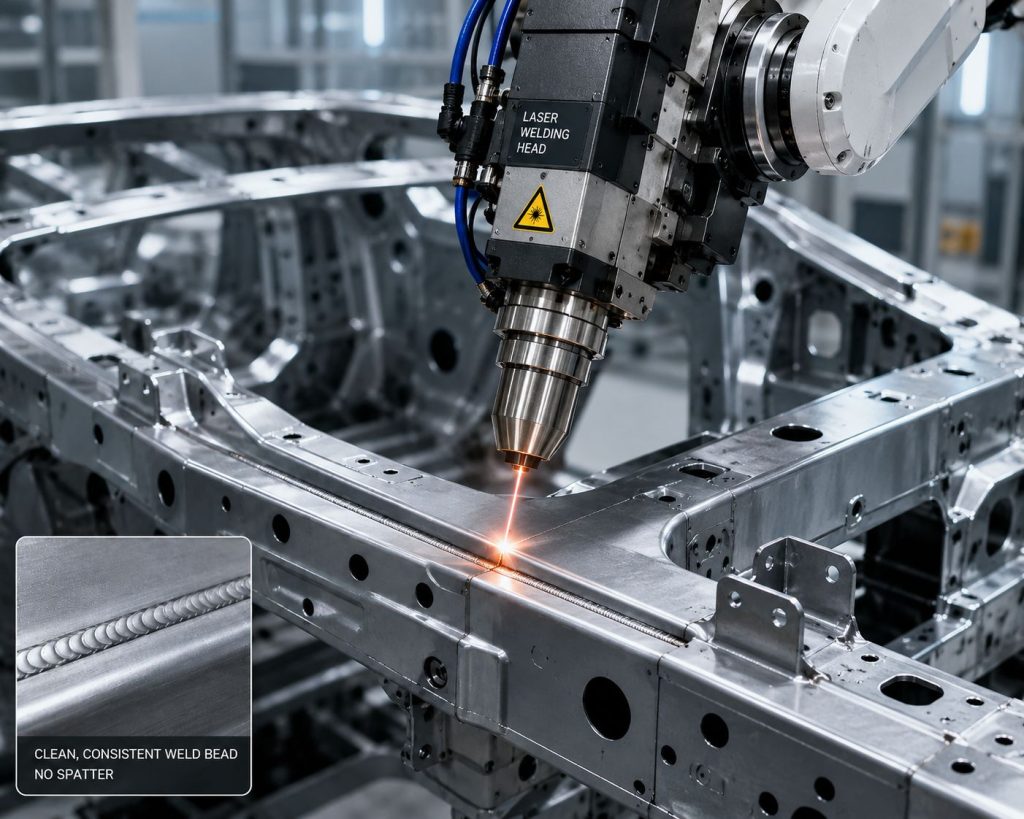
The automotive industry is under constant pressure to produce parts that are lighter, stronger, and more precise than the previous generation. As vehicle platforms grow more complex — and as EV manufacturing introduces entirely new assembly requirements — the quality of every weld joint matters more than it ever has.
Traditional welding methods were built for a different era of production. Today, automotive manufacturers, OEM suppliers, and tier-1 fabricators are turning to the laser welding machine for automotive parts as the technology that actually meets modern production standards — not as a future upgrade, but as an immediate operational necessity.
This blog explains what laser welding delivers, where it outperforms conventional methods, and how integrating laser welding into your production environment translates directly into stronger parts, faster throughput, and fewer rejections.
Why Automotive Suppliers Need Better Welding Technology
Conventional MIG and TIG welding have served the automotive industry for decades. In the right application, they still work. But as vehicle designs evolve — lighter structural steel, complex aluminium assemblies, EV battery enclosures that require hermetic seals — the limitations of arc-based welding become harder to work around.
The Problems Conventional Welding Creates
Heat distortion on thin and lightweight materials. Modern automotive design uses thinner gauge materials to reduce weight. Arc welding generates a wide, poorly controlled heat zone that distorts thin sheet metal, warps flanges, and creates fit-up problems at downstream assembly. On high-strength steel, this heat can alter the material’s mechanical properties precisely where structural integrity is most important.
Inconsistent joint quality. Arc welding quality is heavily operator-dependent. Joint penetration, bead geometry, and HAZ width vary with wire feed rate, arc stability, operator technique, and part fit-up. In a production environment running hundreds of identical assemblies per shift, that variability shows up as rework, dimensional non-conformance, and quality rejections.
Slow cycle times and high consumable costs. MIG welding uses wire, shielding gas, and contact tips — all consumables with ongoing cost. Spatter requires post-weld cleaning. Rework adds cycle time. In high-volume automotive production, these costs accumulate at scale.
EV manufacturing demands a new standard. Battery enclosures, busbar assemblies, cooling plates, and motor housings require weld quality levels — hermetic sealing, low distortion, consistent penetration — that conventional arc welding cannot deliver reliably at production volume. The EV transition has exposed the real ceiling of conventional welding technology in automotive manufacturing.
How Laser Welding Improves Automotive Manufacturing
A laser welding machine delivers a focused, high-energy beam onto a precisely defined weld area — typically 0.1–0.6 mm in diameter at the workpiece surface. The result is a deep, narrow weld bead formed with far less total heat input than any arc-based process.
That single difference — concentrated energy, controlled heat — cascades into a series of manufacturing advantages that conventional welding cannot replicate.
High Precision, Deep Penetration
Laser welding produces a keyhole weld — a deep, narrow fusion zone that penetrates the full joint thickness with consistent geometry. Unlike MIG welding, which relies on wide bead deposition, laser welding achieves full penetration with a weld width often under 1 mm. On automotive structural joints, this means stronger welds in less material space.
Dramatically Reduced Heat-Affected Zone
The heat-affected zone (HAZ) in laser welding is measured in fractions of a millimetre. On high-strength steel chassis components, this means the base material’s mechanical properties are preserved right up to the weld edge. On aluminium battery enclosures, it means less thermal distortion and better dimensional conformance after welding.
Compare this to MIG welding, where HAZ can extend 3–8 mm on either side of the joint — changing material hardness, introducing residual stress, and creating distortion that requires correction before assembly continues.
Faster Production, Higher Throughput
Laser welding speeds on automotive steel and aluminium typically run 3–10x faster than equivalent TIG welding applications. On seam-welded components like battery tray perimeters or tube assemblies, this speed advantage translates directly into lower cycle times and higher parts-per-shift output.
Laser welding is also automation-compatible. The beam is delivered through a fixed or robotic head controlled by CNC or robot arm, with no operator involvement in the weld execution. Programme a weld path once — it runs the same on every part, at full speed, without fatigue or variation.
Cleaner Welds, Less Post-Processing
Laser welding produces minimal spatter, no flux residue, and smooth weld beads that typically require no post-weld grinding or dressing. On visible automotive components — body panels, trim brackets, exterior structural members — this surface quality eliminates a finishing step that arc welding almost always requires.
Stronger, More Consistent Assemblies
The combination of deep penetration, narrow HAZ, and consistent bead geometry produces weld joints with mechanical properties that are consistently closer to the base metal than arc welding achieves. Across a production run of 10,000 brackets or 5,000 frame assemblies, every joint meets the same standard — not a distribution around a standard.
Automotive Applications: Where Laser Welding Delivers
Laser welding is not a single-application technology. Across the full breadth of automotive component manufacturing, it addresses joining challenges that conventional welding handles poorly or not at all.
EV Battery Enclosures and Busbar Welding
EV battery packs require hermetic seals on aluminium enclosures — a leak path in a battery housing is a safety failure. Laser welding produces the consistent, full-penetration seams on thin aluminium that hermetic sealing demands. On busbar assemblies and cell interconnects, laser welding joins dissimilar metals (copper to aluminium, for example) that arc welding cannot handle reliably.
Chassis and Structural Frame Welding
Chassis brackets, sub-frame assemblies, and body-in-white structural members are high-volume, quality-critical components where joint strength and dimensional accuracy directly affect vehicle safety. Laser welding on these applications delivers consistent penetration, low distortion, and no post-weld grinding — keeping production moving without rework interruptions.
As part of a broader shift toward laser-based production, many suppliers are simultaneously adopting laser cutting for these same components. The full context for this transition is explored in Why Automotive Part Makers Are Moving from Conventional Cutting to Laser Cutting — a detailed look at how laser cutting, welding, and marking work together across the automotive supply chain.
Tube Welding for Exhaust and Frame Systems
Automotive exhaust manifolds, frame cross-members, and roll structures require tube-to-tube and tube-to-flange welds at compound angles. Laser welding handles these geometries with robotic head positioning, producing consistent welds on round, square, and profiled tube sections without the spatter and rework associated with MIG welding on tube.
Sheet Metal Assemblies — Brackets, Housings, and Panels
Thin-gauge sheet metal brackets, sensor housings, heat shields, and door reinforcement panels all benefit from laser welding’s low heat input and precise bead geometry. On galvanised and coated steels — common in body-in-white applications — laser welding manages the coating burn-off more controllably than arc welding, producing better surface quality on the finished part.
Aluminium and Stainless Steel Welding
Both materials present challenges for arc welding — aluminium’s high thermal conductivity causes distortion on thin sections, while stainless requires precise heat control to avoid sensitisation and surface oxidation. Laser welding’s focused energy and fast travel speed handle both materials cleanly, making it the preferred joining method for stainless exhaust systems and aluminium structural assemblies.
Metal Joining in Robotic Production Cells
Laser welding integrates directly with robotic production cells and automated transfer systems. Welding programmes are loaded digitally, robots execute the weld path with sub-millimetre repeatability, and vision systems can perform inline weld quality inspection — all without human intervention in the weld cycle. This is the automation architecture that modern automotive OEMs are building toward, and laser welding is central to it.
It is also worth noting that laser technology in automotive manufacturing extends well beyond welding. Laser cutting handles chassis and tube components with the same precision advantage, and laser marking delivers the component-level traceability — piston ring marking, 2D/3D DataMatrix codes, part identification — that OEM supply chain requirements increasingly mandate. These technologies work together as an integrated production system, not as isolated tools.
SLTL Laser Solutions for Automotive Welding and Fabrication
SLTL Group provides a complete range of laser processing systems purpose-built for automotive manufacturing environments — covering cutting, welding, and marking from a single solution provider.
Future X — Advanced Laser Cutting Machine
The Future X is SLTL’s most advanced laser cutting platform, equipped with smart automation features and precision manufacturing capability that gives automotive suppliers a genuine competitive edge. It is designed for suppliers who need to handle complex geometries, tight tolerances, and demanding duty cycles on a single cutting platform.
For automotive fabricators running both laser cutting and laser welding in the same production environment, the Future X handles the cutting side of chassis components, tube stock, and sheet metal with the same precision standard that laser welding delivers on the joining side.
Explore SLTL’s advanced laser cutting machine options for your automotive production line.
Infinity F1 — High Power Laser Cutting Machine
The Infinity F1 is built for heavy-duty automotive manufacturing — thick structural steel, high-volume production, demanding continuous-duty cutting cycles. Where chassis fabrication and structural frame work demands sustained high-power cutting without compromise on edge quality, the Infinity F1 delivers.
Its high power output supports the thick-section cutting that structural automotive components require, complementing laser welding operations downstream by supplying dimensionally accurate, weld-ready parts.
IntegreX — Affordable Laser Cutting Machine
The IntegreX makes laser cutting accessible for tier-2 and tier-3 automotive suppliers who need to improve productivity and cutting efficiency without the capital cost of a top-tier system. It processes standard automotive sheet thicknesses with genuine production capability, making it the practical entry point for suppliers transitioning from conventional cutting to laser-based fabrication.
X5 — 3D Laser Cutting Machine
The X5 specialises in three-dimensional cutting on formed and complex-geometry automotive components — hydroformed panels, deep-drawn structural parts, and any component where cutting happens on a curved or compound surface that a flat-bed machine cannot reach. For automotive applications involving formed part trimming and piercing, the X5 is the specialist platform.
Discover how SLTL’s automotive laser welding systems and cutting solutions integrate into full production environments.
Why Choose SLTL for Automotive Laser Processing
SLTL Group delivers integrated laser cutting, welding, and marking solutions for automotive manufacturers at every tier of the supply chain. Working with SLTL means:
- Smart manufacturing integration — CNC and robotic compatibility across cutting, welding, and marking platforms
- Faster production cycles — Higher throughput on every process versus conventional alternatives
- Better part quality — Consistent precision, reduced HAZ, and clean weld/cut geometry
- Reduced wastage — Lower scrap rates, elimination of secondary operations, minimal consumable cost
- Precision engineering support — Application engineering for your specific material, thickness, and production requirement
- Automation-ready platforms — Systems designed for integration into robotic cells and automated production lines
Whether you are upgrading a welding operation, building a new fabrication cell, or integrating laser marking for traceability compliance, SLTL provides the equipment and application support to make it work in your production environment.
Contact SLTL today to discuss your automotive application, request a sample weld on your specific material, or get a production-ready system specification.
Explore SLTL’s full range of industrial laser marking solutions for automotive traceability and component identification.
Conclusion
The shift toward laser welding in automotive manufacturing is not a trend — it is a response to real production requirements that conventional welding technology cannot meet at modern quality and volume standards. Stronger joints, lower distortion, faster cycle times, and automation compatibility are not incremental improvements. They are the difference between a production process that meets OEM requirements and one that generates rework, rejections, and cost overruns.
For automotive suppliers at every tier, the laser welding machine for automotive parts is the joining technology that the current generation of vehicle design and production demand. And when integrated with laser cutting and laser marking into a complete production system, it delivers the precision, traceability, and throughput that defines the future of automotive manufacturing.
SLTL’s laser cutting, welding, and marking solutions are built for this environment — and for the automotive suppliers who operate in it.
Frequently Asked Questions
Q1: What materials can a laser welding machine weld in automotive production? Laser welding handles mild steel, high-strength steel, aluminium alloys, stainless steel, galvanised sheet, and dissimilar metal combinations including copper-to-aluminium for EV busbar applications. Material-specific parameters — power, pulse duration, speed, and shielding gas — are adjusted per material type.
Q2: How much faster is laser welding compared to TIG welding on automotive components? On most automotive seam and structural welding applications, laser welding runs 3–10x faster than equivalent TIG welding. The exact speed advantage depends on material thickness, joint geometry, and required penetration depth. Faster travel speeds also mean lower heat input per unit length, which reduces distortion on thin-gauge material.
Q3: Is laser welding suitable for EV battery enclosure manufacturing? Yes — laser welding is the preferred process for EV battery enclosures due to its ability to produce hermetic-quality seals on thin aluminium with minimal distortion. It also handles busbar and cell interconnect welding on copper and aluminium substrates that arc welding processes cannot join reliably.
Q4: Can laser welding integrate with robotic production cells? Yes. Laser welding heads are designed for integration with robotic arms, gantry systems, and CNC motion platforms. Weld programmes are loaded digitally, robots execute with sub-millimetre repeatability, and inline inspection systems can verify weld quality within the production cycle — with no manual intervention in the weld execution.
Q5: What is the return on investment timeline for a laser welding machine in automotive manufacturing? ROI depends on production volume, current rework rates, consumable spend, and secondary operation costs. Most automotive suppliers running medium-to-high volume production see payback on laser welding capital investment within 18–36 months, driven by eliminated rework, reduced consumables, faster cycle times, and lower scrap rates.
Leave a Reply