
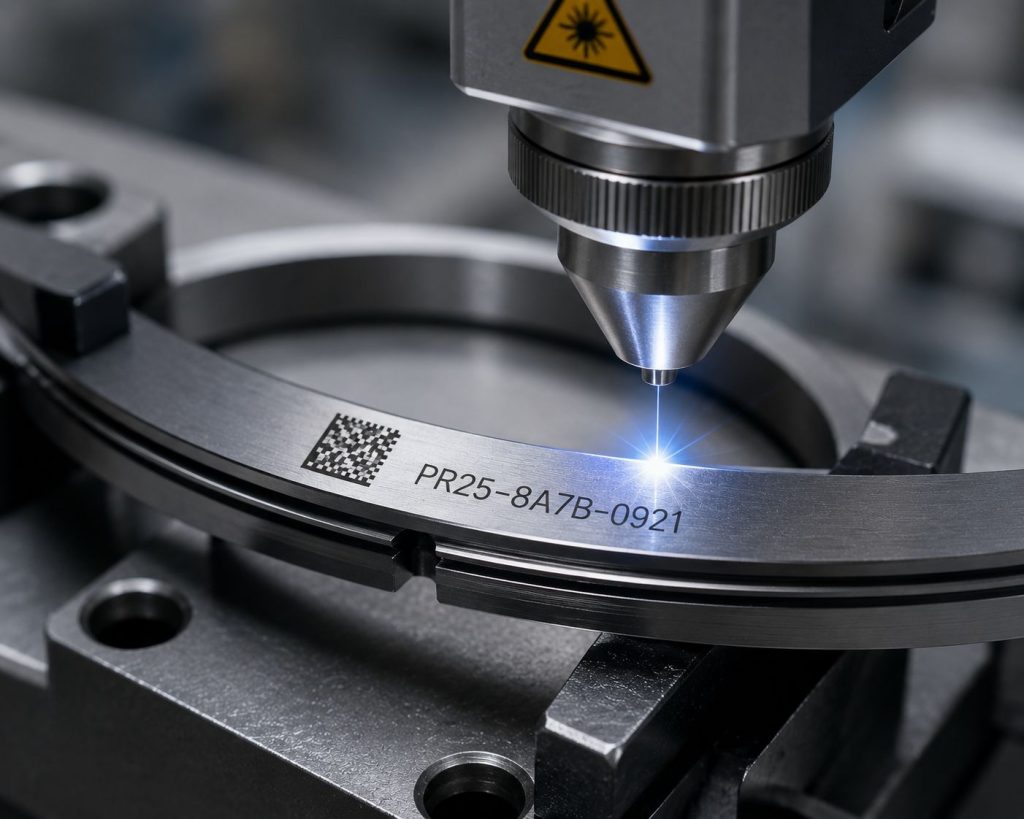
Every engine component tells a story. In automotive manufacturing, that story must be traceable, verifiable, and permanent. A piston ring marking machine makes that possible. It applies precise identification marks — serial numbers, batch codes, DataMatrix — directly onto piston rings with speed and accuracy. As traceability requirements grow tighter across the automotive supply chain, laser marking has become the standard solution for permanent component identification.
Traditional marking methods — dot peen, inkjet, and mechanical stamping — were once enough. Today, they fall short. They cannot survive the thermal and chemical conditions inside a running engine. Moreover, they struggle with small curved surfaces like piston rings. As a result, manufacturers are switching to laser-based marking systems.
Laser marking solves the problem cleanly. It is fast, non-contact, and permanently bonds the mark into the metal surface. Furthermore, it integrates easily into automated production lines. This blog explains what piston ring laser marking is, why it matters, and how it supports modern automotive manufacturing.
Why Piston Ring Marking Matters in Automotive Manufacturing
Piston rings are small. However, their role is critical. They seal the combustion chamber, control oil consumption, and manage heat transfer. A single faulty batch entering the supply chain can cause engine failures at scale.
Therefore, manufacturers must track every ring — from raw material to finished product.
Component Traceability Is Non-Negotiable
OEM customers and regulatory bodies demand complete part histories. Additionally, automotive quality standards like IATF 16949 require component-level traceability. A laser-marked serial number or DataMatrix code on each ring provides this. It links the physical part to its full production record.
Counterfeit Prevention
Counterfeit engine components are a growing problem globally. Permanent laser marks make authentic parts easy to identify. Furthermore, micro-text and DataMatrix codes are extremely difficult to replicate. As a result, brands protect both their products and their reputation.
Batch Tracking and Quality Control
During production, manufacturers run thousands of rings per shift. Laser marking assigns each batch a unique identifier. Consequently, quality teams can isolate and investigate specific batches if issues arise. This reduces warranty costs and speeds up root cause analysis.
Compliance and Warranty Support
Besides quality control, permanent marking supports warranty management. When a ring fails in the field, the mark provides its complete production history. Therefore, manufacturers can identify exactly when and where it was made — and respond faster.
How Laser Marking Works on Piston Rings
A piston ring marking machine uses a focused laser beam to permanently engrave marks onto the ring surface. The process is non-contact. This means the laser never physically touches the component.
The Marking Process — Step by Step
First, the piston ring is loaded into the marking fixture — either manually or via an automated feeder. Next, the CNC programme activates the laser head. The beam focuses onto the curved ring surface with sub-millimetre accuracy. Finally, the mark is formed in seconds and the ring moves to the next station.
The entire cycle takes 3–8 seconds per ring. Moreover, parameter settings — power, speed, pulse duration — are saved digitally. Therefore, every ring in the batch receives an identical mark quality.
Precision on Curved Surfaces
Piston rings present a specific challenge. Their curved outer surface requires a marking system that maintains consistent focus across the arc. Modern fiber laser systems handle this through dynamic focus adjustment. As a result, mark quality is consistent around the full ring circumference.
Permanent Engraving — Built to Last
The laser does not coat the surface. Instead, it changes the surface microstructure of the metal. Consequently, the mark is as durable as the metal itself. It survives:
- Combustion temperatures above 300°C
- Engine oil and lubricant exposure
- Honing fluid and chemical cleaning
- High-pressure combustion cycles
Furthermore, the marks remain scannable even after extended engine operation. This makes them ideal for full-lifecycle traceability.
Automation Compatibility
Laser marking systems integrate directly with production line conveyors, robotic feeders, and vision inspection systems. Additionally, they connect to MES and ERP databases for real-time data capture. Therefore, each marked ring is immediately logged into the production record — without manual data entry.
Compatible Materials
Laser marking works on all standard piston ring materials:
- Cast iron — standard ring material for most petrol engines
- Steel and stainless steel — used in high-performance and diesel applications
- Chrome-plated rings — laser marks cleanly through surface coatings
- Nitrided steel rings — laser handles the hardened surface without distortion
- Engine-grade alloy metals — parameter-adjustable for any alloy composition
Applications of Laser Marking in Automotive Production
Laser marking does not operate in isolation. In a modern automotive plant, it works alongside laser cutting and laser welding as part of an integrated production system. Together, these technologies deliver precision, traceability, and automation across the full manufacturing cycle.
Piston Ring Marking
This is the primary application. Each ring receives a unique serial number, batch code, and DataMatrix mark. Furthermore, the mark links to a central production database. Quality teams can track every ring from raw material to shipped component.
Chassis Cutting and Structural Components
Laser cutting handles chassis rails, brackets, and structural members with the same precision that marking brings to component identification. Moreover, laser-cut edges are weld-ready — reducing secondary operations. The broader shift toward laser-based production in automotive manufacturing is detailed in Why Automotive Part Makers Are Moving from Conventional Cutting to Laser Cutting — a comprehensive look at how cutting, welding, and marking work together across the supply chain.
Tube Cutting for Frames and Exhaust Systems
Tube laser cutting supports frame assembly, exhaust manifolds, and roll structures. Additionally, laser-cut tube joints improve weld fit-up accuracy. This reduces rework and speeds up downstream assembly.
Airbag and Composite Material Processing
Airbag fabric and composite panels require contactless cutting. Laser cutting delivers this without fraying, delamination, or edge contamination. Furthermore, it handles delicate safety materials without the mechanical damage that blade-based tools cause.
2D and 3D Job Marking
Beyond piston rings, automotive laser marking covers a wide component range. Connecting rods, camshafts, cylinder bores, and cast housings all require permanent identification. Additionally, 3D marking systems handle curved and compound surfaces that flat-plane marking cannot reach accurately.
Smart Factory Integration
Modern laser marking systems connect directly to smart factory infrastructure. They communicate with SCADA systems, MES platforms, and quality databases in real time. Consequently, every marked component is tracked automatically — without manual scanning or data entry. This is the foundation of Industry 4.0 traceability in automotive manufacturing.
Benefits of Laser Marking for Automotive Suppliers
Switching from conventional marking to laser delivers measurable advantages across production. Here is what automotive suppliers gain.
Permanent Traceability
Laser marks last the full lifetime of the component. Unlike inkjet marks that fade or dot-peen marks that crack under thermal stress, laser engravings survive every condition inside a working engine. Therefore, full-lifecycle traceability is achievable without additional protective treatments.
Faster Production Cycles
A laser marking cycle on a piston ring takes 3–8 seconds. Moreover, automated feeding and inline marking eliminate manual handling between production steps. As a result, overall throughput increases significantly compared to conventional marking methods.
High Precision at Small Scale
Piston rings have very limited marking surface area. However, laser marking handles this constraint easily. It applies serial numbers, DataMatrix codes, and batch IDs at character heights below 0.5 mm — remaining readable under magnification and scannable by industrial readers.
Reduced Maintenance Costs
Conventional marking tools require regular replacement — ink cartridges, stylus tips, electrode contacts. In contrast, laser marking systems have no consumables beyond protective lenses. Consequently, ongoing maintenance costs are significantly lower over a 5–10 year equipment lifespan.
Improved Readability and Scan Rates
High-contrast laser marks produce reliable scan rates in automated vision inspection systems. Furthermore, consistent mark geometry — achieved through digital parameter control — eliminates the scan failures that variable-depth mechanical marks cause. As a result, production line throughput stays consistent without marking-related stoppages.
Industry 4.0 Readiness
Laser marking systems are built for digital integration. They support serial communication, OPC-UA protocols, and direct database connectivity. Therefore, they fit naturally into smart factory architectures where every component carries traceable data from production through to end-of-life.
Additionally, laser marking supports predictive quality programmes by feeding real-time production data into analytics platforms — enabling manufacturers to identify quality trends before they become warranty issues.
SLTL Laser Solutions for Automotive Marking and Fabrication
SLTL Group delivers integrated laser cutting, welding, and marking solutions for automotive manufacturers at every production tier. Each platform is designed for automotive production environments — precision, reliability, and automation compatibility built in.
Future X — Advanced Laser Cutting Machine
The Future X is SLTL’s most advanced laser cutting platform. It brings smart automation features and precision cutting capability to demanding automotive production environments. Furthermore, it gives manufacturers a genuine competitive edge — handling complex part geometries, tight tolerances, and mixed-material production on a single platform.
For automotive fabricators running laser cutting alongside laser marking, the Future X handles chassis components, tube stock, and sheet metal with the same precision standard that marking systems deliver on identification. Explore SLTL’s automotive laser cutting machine range for your production environment.
Infinity F1 — High Power Laser Cutting Machine
The Infinity F1 is built for heavy-duty automotive manufacturing. It cuts thick structural steel and runs high-volume production cycles without compromise on edge quality. Moreover, it supports the sustained cutting power that chassis fabrication and structural frame work demands — consistently, shift after shift.
Its high-power output makes it the right choice for automotive suppliers cutting 6–20 mm structural sections at production volume.
IntegreX — Affordable Laser Cutting Machine
The IntegreX makes precision laser cutting accessible for tier-2 and tier-3 automotive suppliers. It processes standard automotive sheet thicknesses efficiently. Furthermore, it delivers genuine production capability — improved throughput, better cut quality, and reduced secondary operations — at an accessible acquisition cost.
For suppliers currently running conventional cutting processes, the IntegreX is the practical entry point into laser-based fabrication.
X5 — 3D Laser Cutting Machine
The X5 specialises in three-dimensional cutting on complex automotive components. It handles hydroformed panels, deep-drawn parts, and any component where cutting happens on a curved or compound surface. Additionally, it supports the compound bevel cuts and piercing operations that formed parts require after the stamping or hydroforming process.
Discover how SLTL’s precision laser marking solutions and cutting systems integrate into complete automotive production environments.
Modernize Your Automotive Production with SLTL Laser Technology
Automotive manufacturers face growing pressure — tighter tolerances, stricter traceability requirements, faster delivery windows, and more complex component geometries. Conventional marking and cutting methods cannot keep pace.
SLTL’s integrated laser solutions address this across every production step.
What SLTL laser technology delivers:
- Permanent traceability — laser marks that survive the full component lifecycle
- Faster production — 3–8 second marking cycles, automated feeding, no consumable changes
- Smart automation — direct MES, ERP, and SCADA integration from day one
- Precision manufacturing — sub-millimetre mark accuracy on curved and complex surfaces
- Reduced wastage — lower scrap rates, eliminated secondary operations, no rework from marking errors
- Better quality control — consistent mark geometry enabling reliable automated inspection
- Industry 4.0 readiness — digital-native systems built for connected manufacturing environments
Contact SLTL today to discuss your piston ring marking application, request a live demonstration, or specify the right system for your production volume and traceability requirements.
Conclusion
Piston ring laser marking is not a luxury addition to automotive production. It is a fundamental requirement of modern engine component manufacturing. The piston ring marking machine delivers permanent, precise, and automation-compatible identification that conventional methods simply cannot match.
Furthermore, laser marking does not work alone. It is most powerful when integrated with laser cutting and laser welding as part of a complete production system. Together, these technologies deliver the precision, traceability, and throughput that automotive OEMs and tier-1 suppliers now expect as standard.
The future of automotive manufacturing is laser-enabled, data-connected, and traceable at the component level. SLTL’s cutting, welding, and marking solutions are built for exactly this environment.
Frequently Asked Questions
Q1: How durable is a laser mark on a piston ring in engine conditions?
Laser marks on piston rings are permanent. The mark is formed by a change in the metal’s surface microstructure — not a coating or ink. Therefore, it survives combustion temperatures, oil exposure, honing fluid, and high-pressure cycles without fading or degrading. Marks applied during production remain readable after thousands of hours of engine operation.
Q2: What marking speed can a piston ring marking machine achieve in production?
A standard laser marking cycle on a piston ring takes 3–8 seconds per component. This includes serial number, batch code, and DataMatrix engraving in a single operation. Furthermore, automated feeding systems eliminate handling time between cycles — enabling continuous production throughput without manual intervention.
Q3: Can a piston ring marking machine handle different ring sizes and materials?
Yes. Laser marking systems use digitally controlled parameters — power, speed, pulse duration, focus — that are adjustable per material and ring geometry. As a result, a single marking system handles cast iron, steel, stainless steel, chrome-plated, and nitrided rings across different diameters without physical tooling changes.
Q4: Does laser marking integrate with automotive MES and ERP systems?
Yes. Modern laser marking machines support standard industrial communication protocols including OPC-UA, serial RS-232, and Ethernet connectivity. Consequently, each marked component is logged directly to the production database in real time — without manual data entry or secondary scanning steps.
Q5: What is the return on investment timeline for a piston ring laser marking system?
ROI depends on production volume, current marking method, and scrap/rework rates. Most automotive suppliers running medium-to-high volume piston ring production see payback within 18–30 months. Key savings come from eliminated consumables, reduced rework from marking failures, faster cycle times, and lower maintenance costs compared to dot-peen or inkjet systems.

Leave a Reply