
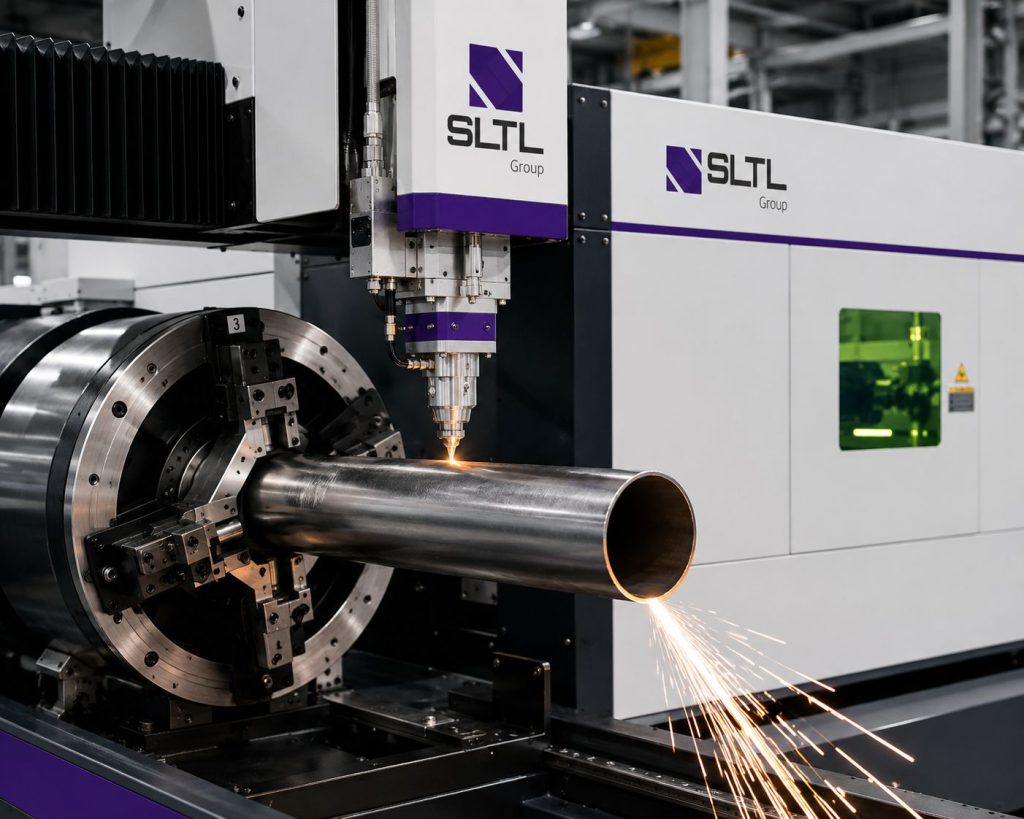
Modern vehicles use more tubular structures than ever before. Exhaust systems, seat frames, chassis reinforcements, roll cages, and EV structural assemblies all rely on precisely cut tube components. Meeting the dimensional accuracy and production speed that automotive OEMs demand requires the right technology. A tube laser cutting machine for automotive production delivers exactly that — precision tube processing at speeds and quality levels that conventional sawing and plasma simply cannot match.
As automotive manufacturing evolves, the need for faster, smarter, and more precise tube processing grows with it. Traditional tube cutting methods struggle with complex joint geometries, tight tolerances, and the mixed tube profiles that modern vehicle platforms require. Furthermore, they introduce secondary operations — deburring, grinding, manual fitting — that add time and cost to every production batch.
Laser-based tube processing eliminates these problems. It handles round, square, rectangular, and custom tube profiles in a single automated operation. As a result, manufacturers gain better fit-up quality, fewer assembly errors, and faster overall throughput. This blog explains how tube laser cutting works, where it delivers the most value in automotive production, and which SLTL solutions are built for this application.
Why Tube Laser Cutting Matters in Automotive Manufacturing
Tubular structures are fundamental to modern vehicle design. They appear in safety systems, powertrain components, structural assemblies, and body frameworks. Furthermore, they are growing in importance as vehicle platforms shift toward lightweight construction and EV architecture.
Tubes Are Everywhere in Modern Vehicles
Every passenger vehicle contains dozens of tube-based components. Exhaust pipes and manifolds carry combustion gases from the engine. Seat frame tubes form the structural skeleton of seating systems. Chassis cross-members and sub-frame tubes carry lateral and torsional loads. Roll cages in performance vehicles protect occupants during impacts.
Additionally, EV platforms introduce new tubular requirements. Battery pack structural frames, cooling tube assemblies, and lightweight body reinforcements all demand precision-cut tube components at production volume.
Conventional Tube Cutting Falls Short
Mechanical sewing produces flat, perpendicular cuts. However, automotive tube joints are rarely perpendicular to the individual. Frame members meet at compound angles. Exhaust branches use saddle cuts and notched ends for fit-up. Seat frame tubes require slotted ends and through holes in specific positions.
Achieving these geometries with conventional tools requires multiple separate operations — sewing, then notching, then drilling, then grinding. Consequently, production time multiplies, and dimensional accuracy degrades with each additional step.
Laser Tube Cutting Solves the Problem Directly
A tube laser cutting machine for automotive applications handles all these geometries in a single automated operation. Compound bevel cuts, saddle notches, through-holes, and slotted ends are all programmed digitally and executed in one pass. Therefore, secondary operations are eliminated — and joint fit-up accuracy improves dramatically.
Benefits of a Tube Laser Cutting Machine for Automotive Production
Switching from conventional tube cutting to laser processing delivers measurable advantages across the production floor. Here is what automotive manufacturers gain.
Faster Production Speed
A tube laser cutting machine processes tubes significantly faster than mechanical methods. Moreover, automated chuck systems feed and index tubes continuously — eliminating manual repositioning between cuts. As a result, throughput increases substantially compared to saw-based production lines.
On a standard exhaust pipe cutting operation, laser systems typically run 3–5x faster than equivalent mechanical cutting setups. Furthermore, programmed changeover between tube profiles takes under 60 seconds — no tooling changes are required.
Better Edge Quality and Fit-Up Accuracy
Laser cutting produces clean, square cut edges without burrs or dross on most automotive tube materials. Therefore, weld preparation is significantly reduced. Tube joints fit together accurately from the first cut — with gap tolerances typically within ±0.1 mm.
This edge quality translates directly into better weld quality downstream. Better-fitting joints require less filler metal, less heat input, and produce stronger, more consistent welds.
High Repeatability Across Production Runs
A tube laser cutting machine operates from a digital CNC programmed. The programmed does not wear, drift, or change with operator fatigue. Consequently, the ten-thousandth tube cut identically to the first. This repeatability is critical in automotive production, where assembly fixtures are designed around specific dimensional standards.
Reduced Material Waste
Laser tube cutting software optimizes the cut sequence across each tube length. As a result, off-cuts and scrap are minimized. On expensive materials like stainless steel exhaust tube or aluminum chassis sections, this material saving has a direct impact on production cost.
Lower Maintenance Requirements
Laser cutting systems have no physical cutting tools to wear or replace — unlike saw blades, grinding wheels, or plasma electrodes. The primary consumables are nozzles and protective lenses — low-cost items with long service intervals. Therefore, maintenance downtime is minimal and predictable.
Flexible Production Capability
A single tube laser cutting machine handles multiple tube profiles, sizes, and materials. Switching between a round exhaust tube and a rectangular seat frame section requires only a programmed change and a chuck adjustment — not new tooling. Additionally, this flexibility makes laser cutting the right technology for mixed-model production environments where batch sizes are small, and profile variety is high.
How Tube Laser Cutting Improves Exhaust and Frame Manufacturing
The tube laser cutting machine for automotive production is not a general-purpose tool. It is specifically designed for the joint geometries, production volumes, and material types that automotive exhaust and frame manufacturing require.
Non-Contact Laser Cutting Process
The laser beam never physically contacts the tube. Instead, it focuses on a high-energy beam onto the tube surface, melting and vaporizing material along the programmed cut path. Consequently, there is no mechanical force on the tube — no distortion from blade pressure, no dimensional shift from tool deflection.
This is particularly important on thin-wall exhaust tubes, where mechanical cutting forces can ovalize the tube cross-section and compromise downstream assembly fit.
CNC-Controlled Tube Processing
Every cut is governed by a CNC programme. The programme defines the cut geometry, the tube rotation angle, and the cutting head position for every operation on the tube. Furthermore, it handles compound cuts — angles, bevels, and saddle profiles — without any manual intervention.
As a result, complex exhaust branch cuts and chassis node geometries that would require skilled manual labour with conventional tools are produced automatically at full production speed.
Complex Profile Cutting Capability
The tube laser cutting machine for automotive applications handles the full range of tube profiles used in vehicle manufacturing:
- Round tubes — exhaust pipes, roll cage members, seat frame tubes
- Square tubes — chassis cross-members, structural reinforcements
- Rectangular tubes — seat base frames, underbody structural members
- Custom profiles — hydroformed sections, oval exhaust tubes, D-section roll bars
Additionally, the laser handles all common automotive tube materials:
- Mild steel — standard chassis and frame applications
- Stainless steel — exhaust systems requiring corrosion resistance
- Aluminium — lightweight EV structural components
- High-strength steel alloys — safety-critical chassis and roll structure members
Burr-Free Cutting
Properly optimised laser tube cutting produces clean, burr-free cut edges on most automotive steel and aluminium tube thicknesses. Therefore, deburring is eliminated as a production step. This saves labour time and removes a variable that can affect downstream weld quality if performed inconsistently.
Automation Compatibility
Tube laser cutting machines integrate with bar feed systems, automated bundle loaders, and robotic unloading stations. Consequently, the full tube processing cycle — from raw stock to cut components — runs automatically with minimal operator intervention. This is the production architecture that modern automotive OEMs expect from their suppliers.
Applications of a Tube Laser Cutting Machine for Automotive Components
The tube laser cutting machine for automotive production covers a broad range of component types. Here is where it delivers the most value.
Exhaust System Manufacturing
Exhaust systems require precise tube cuts at complex angles — branch pipe junctions, manifold collector profiles, and flex section ends. Laser cutting handles all of these in a single operation without secondary grinding. Furthermore, the clean cut edge improves sealing surface quality at gasket joints. As a result, exhaust assembly fit-up is faster and more consistent.
Automotive Frame and Sub-Frame Fabrication
Chassis rails, sub-frame cross-members, and structural node tubes require dimensional accuracy that mechanical cutting cannot consistently deliver. Laser tube cutting produces these components to ±0.1 mm tolerance — tight enough for direct assembly into welding fixtures without measurement or fitting adjustment.
The broader case for laser-based production in automotive fabrication — covering chassis cutting, sheet metal, and integrated marking — is explored in detail in Why Automotive Part Makers Are Moving from Conventional Cutting to Laser Cutting. It is worth reading alongside this blog for the full picture of how laser technologies work together in automotive production.
Seat Structure Manufacturing
Automotive seat frames use multiple tube sections joined at compound angles. Laser cutting produces the notched and bevelled ends that seat frame joints require — with the consistency across production volume that manual notching cannot achieve. Additionally, through-holes for attachment hardware are cut in the same operation as the tube ends.
EV Chassis and Battery Frame Components
EV platforms introduce lightweight aluminium tube assemblies that require the same precision as steel structures — but with the additional challenge of aluminium’s higher thermal conductivity and sensitivity to heat input. Laser tube cutting handles aluminium cleanly with optimised parameters, producing weld-ready edges without the distortion that saw cutting can introduce on thin aluminium wall sections.
Structural Reinforcements and Roll Cages
Safety-critical structural tubes — B-pillar reinforcements, door intrusion beams, roll cage members — require tight dimensional tolerances and verified joint geometry. Laser tube cutting delivers both, with digital programme control that eliminates the operator variability of manual notching.
Integrated Cutting, Welding, and Marking in Automotive Production
Tube laser cutting is most powerful as part of an integrated production system. After cutting, tubes move directly to laser welding — where the clean, accurate laser-cut edges produce tight joint fit-up and high-quality welds. After welding, laser marking applies part numbers, batch codes, and traceability DataMatrix codes to the finished assembly.
Additionally, laser marking on flat sheet components — piston ring identification, 2D/3D DataMatrix codes, chassis bracket part numbers — completes the traceability picture across the full vehicle component set. These technologies work together as a complete laser production system, not as isolated tools.
For automotive manufacturers also processing sheet metal alongside tube work, SLTL’s flat sheet laser cutting solutions extend the same precision advantage to body panels, brackets, and structural sheet components.
SLTL Solutions for Automotive Tube Processing
SLTL Group provides a complete range of laser cutting platforms for automotive tube processing — from entry-level systems for tier-2 suppliers to advanced automation platforms for high-volume OEM production environments.
Future X — Advanced Laser Cutting Machine
The Future X is SLTL’s most advanced laser cutting platform. It brings smart automation features and precision cutting capability that give automotive suppliers a genuine competitive edge. Furthermore, it handles complex tube geometries, tight tolerances, and demanding mixed-profile production on a single platform.
For automotive fabricators running tube cutting alongside flat sheet processing, the Future X delivers consistent precision across both applications. Explore SLTL’s tube laser cutting machine for automotive production range.
Infinity F1 — High Power Laser Cutting Machine
The Infinity F1 is built for heavy-duty automotive manufacturing. It cuts thick-wall structural tubes and chassis sections at high speeds without compromise on edge quality. Moreover, its sustained high-power output handles the continuous duty cycles of volume automotive tube production.
For suppliers cutting 4–12 mm wall thickness structural steel or aluminium sections at volume, the Infinity F1 delivers the throughput and edge quality that downstream welding requires.
IntegreX — Affordable Laser Cutting Machine
The IntegreX makes precision tube laser cutting accessible for tier-2 and tier-3 automotive suppliers. It processes standard automotive tube thicknesses efficiently. Furthermore, it delivers genuine production capability — better edge quality, faster cycle times, and eliminated secondary operations — at an accessible acquisition cost.
For suppliers currently running conventional tube cutting processes, the IntegreX is the practical entry point into laser-based tube fabrication. Discover SLTL’s automotive tube processing solutions for your production tier.
X5 — 3D Laser Cutting Machine
The X5 specialises in three-dimensional cutting on complex automotive tube and formed component geometries. It handles compound surface cutting that standard chuck-based systems cannot reach — formed hydroformed sections, complex 3D structural nodes, and non-standard tube profiles that require multi-axis cutting head positioning.
Additionally, the X5 supports the trimming and piercing of formed tube assemblies after bending — producing the final joint geometry in three dimensions without secondary fixturing.
Modernize Automotive Tube Production with SLTL Laser Technology
Automotive manufacturers face growing pressure — tighter component tolerances, faster delivery windows, more complex tube geometries, and increasing material variety. Conventional tube cutting methods cannot keep pace.
SLTL’s laser cutting, welding, and marking solutions address this across every production step.
What SLTL tube laser cutting delivers:
- Faster tube processing — automated chuck feeding, no tooling changes, sub-minute profile switching
- Smart automation — integration with bar feeders, robotic unloaders, and MES systems
- Precision manufacturing — ±0.1 mm joint geometry for direct weld fixture assembly
- Reduced wastage — optimised nesting software minimises tube off-cut scrap
- Better quality control — burr-free edges and consistent dimensions on every cut component
- Flexible production — round, square, rectangular, and custom profiles on one machine
- Industry 4.0 readiness — digital-native CNC systems with full data connectivity
Contact SLTL today to discuss your tube cutting application, request a sample cut on your specific tube profile and material, or specify the right system for your production volume and geometry requirements.
Conclusion
Precision tube processing is not a secondary concern in automotive manufacturing — it is central to the quality, speed, and cost-efficiency of frame, exhaust, and structural component production. A tube laser cutting machine for automotive production delivers the accuracy, automation, and flexibility that modern vehicle manufacturing demands.
Furthermore, tube laser cutting delivers its full value as part of an integrated system. Combined with laser welding for joint assembly and laser marking for component traceability, it completes a production workflow that is faster, more precise, and more traceable than conventional manufacturing at every step.
The automotive manufacturers who adopt tube laser cutting today are building the production capability that OEM supply chain requirements will demand tomorrow. SLTL’s laser solutions are built to support that transition — from the first sample cut to full-volume automated production.
Frequently Asked Questions
Q1: What tube sizes and profiles can a tube laser cutting machine for automotive handle? Modern tube laser cutting machines handle round tubes typically from 20 mm to 220 mm outer diameter, plus square and rectangular profiles within the same size range. Additionally, they process custom profiles including oval, D-section, and hydroformed sections — with profile-specific chuck jaws for secure fixturing.
Q2: What materials can automotive tube laser cutting machines process? Tube laser cutting machines handle all standard automotive tube materials. These include mild steel, high-strength steel alloys, stainless steel, and aluminium. Parameter settings — power, speed, assist gas — are adjusted per material. Therefore, a single machine covers the full material range without physical tooling changes.
Q3: How does tube laser cutting speed compare to conventional sawing in automotive production? On most automotive tube applications, laser cutting runs 3–5x faster than mechanical sawing for comparable tube diameters and wall thicknesses. Furthermore, laser cutting eliminates the secondary deburring and notching steps that saw-cut tubes typically require — multiplying the overall production time advantage significantly.
Q4: Can tube laser cutting machines handle complex joint geometries for automotive frame assembly? Yes. CNC-controlled tube laser cutting systems produce compound bevel cuts, saddle notches, coped ends, and through-holes in a single automated operation. Furthermore, the digital programme defines the geometry precisely — producing joint fit-up accuracy within ±0.1 mm. As a result, assembly fixture fit-up requires no additional grinding or manual adjustment.
Q5: Does tube laser cutting integrate with automated production lines in automotive manufacturing? Yes. SLTL tube laser cutting machines integrate with bar feed systems, robotic bundle loaders, conveyor unloading, and MES/ERP data systems. Consequently, the full tube processing cycle — from raw stock input to cut component output — runs automatically. This makes tube laser cutting fully compatible with Industry 4.0 automotive production environments.

Leave a Reply